


Introduction
Your customers do not care how many tools you have. They care whether you understand them, reach them at the right moment, and make every interaction feel like it was meant for them. Most engagement platforms promise this. Almost none deliver it. The reason is simple: they are still built on static rules and rigid diagrams. Agentic Customer Engagement (ACE) is the shift that changes this. It replaces brittle workflows with AI agents that reason, decide, and act across every touchpoint. This guide shows you what that shift looks like in practice and how Ephanti makes it real.
The Problem: Rules Based Engagement Has Hit Its Ceiling
Here is the reality most marketing and CX leaders are living with right now.
You have got five, maybe eight tools in your stack. One for email. One for SMS. Another for WhatsApp. A CRM that is supposed to tie it all together but mostly just holds contact records. Each tool owns a slice of your customer data, and none of them share context well enough to give you a complete picture.
So your team spends more time stitching systems together than engaging customers. Your “journeys” are really just flowcharts that break the moment a customer does something you did not anticipate. Your personalization tops out at a first name in a subject line. And every time you want to change a campaign or update a rule, someone has to redraw a diagram or file a ticket with engineering.
Meanwhile, customers keep raising the bar. They expect relevant messages on the channel they prefer, at the moment that matters, with full context from every interaction they have had with your brand. And they are not going to wait while your team debugs a 50 node workflow.
The problem is not that you need more tools. The problem is that your tools are built on the wrong logic. Static rules and “if this then that” paths were designed for a simpler era. The complexity of modern customer engagement has outgrown them.
The shift that is happening right now moves from rules based engagement to Agentic Customer Engagement, where intelligent AI agents handle the reasoning, the decisions, and the execution across your entire customer lifecycle. That is what ACE is. And the brands that adopt it first will set the standard everyone else scrambles to match.
The Framework: Five Steps to ACE Your Customer Engagement
The ACE approach is not about adding another tool to your stack. It is about rethinking how engagement works from the ground up. Here are the five building blocks.
Step 1. Meet customers where intent lives, not just where channels exist
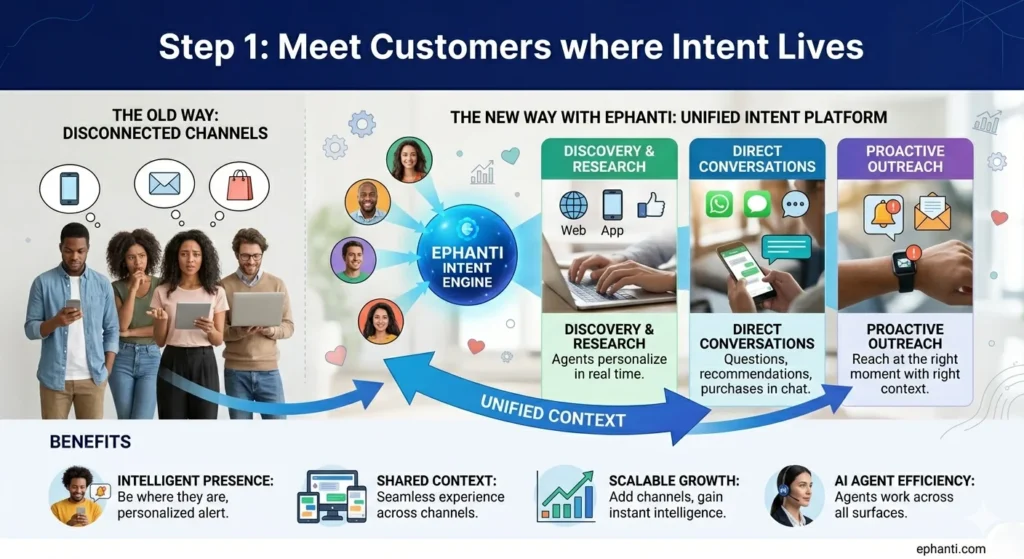
Before you can ACE customer engagement, you need to actually reach customers in the moments that matter. And doing that with a patchwork of disconnected point solutions is what creates the problem in the first place.
But reaching customers is not just about having access to channels. It is about understanding why a customer is on a particular channel and what they need in that moment. A customer browsing your website has a different intent than one messaging you on WhatsApp about an order. Someone opening a push notification is in a different headspace than someone clicking through a marketing email.
Ephanti brings all of these touchpoints into a single platform and organizes them around customer intent:
For discovery and research
your website, mobile app, and social media platforms like Facebook, Instagram, and LinkedIn become connected surfaces where agents can personalize what customers see in real time.
For direct conversations and transactions
messaging channels like WhatsApp, SMS, Apple Messages for Business, and RCS give customers a way to ask questions, get recommendations, and even complete purchases without leaving the chat.
For proactive outreach and nurture
email, push notifications, and broadcast messaging let you reach customers at the right moment with the right context, not just on a schedule.
The point is not to be everywhere for the sake of it. The point is to be intelligent everywhere. When you consolidate channels into one platform, your agents share context across all of them. A conversation that starts on your website and moves to WhatsApp does not lose its thread. A customer who ignores an email but opens every push notification gets reached on the channel that actually works for them.
You do not have to go all in on every channel from day one either. Start with one or two. See the impact. Then expand. Because Ephanti’s AI agents work across all connected channels from the start, every channel you add immediately benefits from the intelligence already built into the system.
Step 2. Unify your customer data and let agents segment for you
Bringing channels together is just the beginning. The real unlock is what happens when you bring your data together too.
Ephanti connects to your existing systems without requiring you to rip anything out. It pulls in customer data from CRMs, ad platforms, analytics tools, eCommerce systems, and marketing automation through a flexible API and prebuilt integrations for popular platforms like Salesforce, HubSpot, SAP, Workday, MS Dynamics, ServiceNow, and others. Cloud or on premise, it works with what you have.
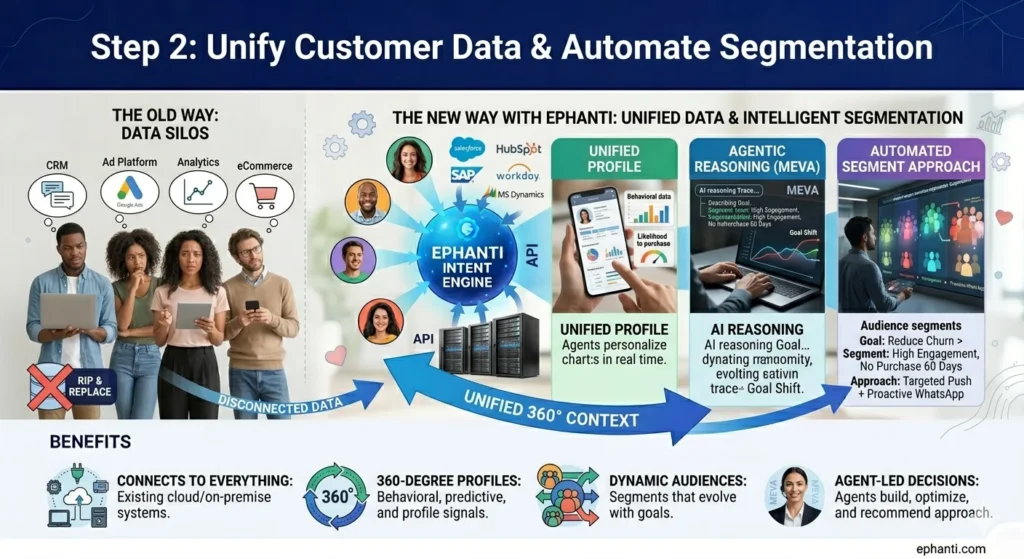
Once your data is unified, Ephanti automatically builds detailed 360 degree customer profiles. You get names, demographics, channel preferences. Predictive signals like likelihood to purchase or engage on a specific channel. Behavioral data from website visits, messaging interactions, purchase history, and more.
Now here is where the agentic part kicks in. Most platforms hand you segmentation tools and leave you to figure out the rest. Ephanti’s MEVA, the intelligence layer that powers all your AI agents, actually reasons with your data. Tell MEVA what you are trying to achieve and it builds the right audience segment for you. Dynamic segments that evolve as your campaign goals shift.
Say you want to reduce churn among customers who have not purchased in 60 days but have high engagement scores. On a traditional platform, that is a manual query with multiple filters. With MEVA, you describe the goal and the agent builds the segment, identifies the right channels for each customer in that group, and recommends the engagement approach.
Traditional platforms give you segmentation tools. Ephanti gives you an agent that segments for you.
Step 3. Personalize with agents, not just algorithms
With unified data and smart segments in place, the next step is making every interaction feel relevant. Not just “Hi [First Name]” relevant. Actually relevant to what that customer needs right now.
Ephanti does this differently because personalization is not template driven. It is agent driven. MEVA’s AI agents analyze customer context in real time and autonomously decide what to show, what to say, and what to recommend.
Here is a concrete example of what agent driven personalization looks like. A customer messages your brand on WhatsApp complaining about a late delivery. At the same time, they have a high value cart sitting open on your website. A traditional platform would not connect these two events. It might even send a promotional SMS about the items in that cart while the customer is mid-complaint. MEVA recognizes the situation, pauses the promotional outreach to avoid looking tone deaf, prioritizes resolving the delivery issue, and then re-engages with the cart at the right moment once the customer’s concern is handled. That is not a pre-programmed rule. That is an agent reasoning in real time.
On your website, this intelligence shows up as product recommendations tailored to each visitor based on what they have browsed, what they have bought, what is trending, and what similar customers are engaging with.
Across other channels, the same depth applies:
campaigns adapt to each scenario, from welcome flows to price drop alerts to repeat purchase nudges, with MEVA generating and optimizing content automatically.
becomes a full engagement channel with personalized promos, reminders, and even end-to-end shopping where customers browse, add to cart, and buy without ever leaving the chat.
SMS, push notifications, RCS, and social messaging
all benefit from the same agent-driven intelligence.
Paid ads
get sharper targeting through Ephanti’s AI driven segments, based on real behaviors and predictive characteristics, not just demographics.
The difference with an ACE approach is that your agents do not just personalize content. They personalize timing, channel selection, and next best action. Continuously. Across every touchpoint. From one place.
Step 4. Let MEVA orchestrate journeys, not diagrams
This is where most platforms hit a wall. And where Ephanti’s ACE approach really separates itself.
Traditional journey builders work on “if this then that” logic. You draw a path, connect some boxes, and hope the customer follows the script. Fine for a simple demo. But at scale, when you are managing dozens of scenarios across multiple channels, those diagrams become brittle. Hard to debug. Impossible for non-technical teams to update. And the person who actually understands the customer ends up waiting on a developer to redraw the workflow every time something changes.
Ephanti flips this entirely. Instead of asking you to build a path, Ephanti asks you to define a goal.
MEVA is the intelligence layer that powers every Ephanti agent. Rather than forcing business logic into box and wire diagrams, MEVA lets you instruct agents the way you would onboard a sharp new team member. You give them your business playbooks and they operate from that understanding.
A playbook is not something extra you need to create. It is the business knowledge your team already has: your brand guidelines, your escalation rules, your product catalog, your engagement policies, your returns process. The kind of documentation that lives in your wiki or your team lead’s head. You upload it as a knowledge base, and MEVA’s agents draw on it to reason through every customer interaction.
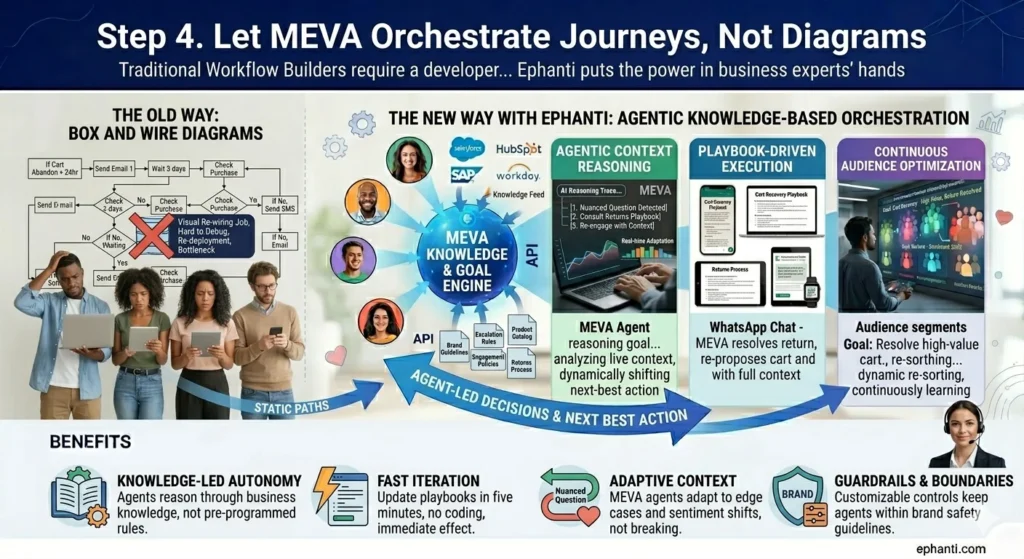
Need a cart recovery agent? Do not draw a 30 node diagram. Give MEVA your recovery playbook and let it run. Need to change the logic? Update the playbook. That is a text based change, not a visual re-wiring job. No re-deployment. No developer ticket. The change takes effect right away. That distinction matters more than it sounds. Updating a document is something any marketing lead or service manager can do in five minutes. Updating a visual workflow usually means scheduling time with someone technical, testing edge cases, and re-deploying. One scales. The other creates bottlenecks.
This is what makes Ephanti’s orchestration genuinely agentic. MEVA’s LLM-powered agents do not follow static paths. They understand intent, adapt to context, and make real time decisions about what to do next. When something unexpected happens, like a nuanced customer question, an edge case, or a sentiment shift, MEVA does not break. It reasons through your business knowledge, adapts, and responds intelligently.
And for enterprise teams who worry about AI going off-script: Ephanti includes built-in guardrails, brand safety controls, and customizable boundaries that keep agents operating within the guidelines your team defines. Your agents are autonomous, but they are not unsupervised.
Traditional workflow builders require a developer to construct every path. Ephanti puts the power in the hands of business experts. Marketing leads, service managers, and domain specialists shape how agents behave by refining the knowledge those agents draw from. No code. No diagrams. Just faster iteration, fewer bottlenecks, and AI that reflects real operational expertise from day one.
That is the ACE way to orchestrate journeys. Not by drawing more lines, but by giving your agents the knowledge and authority to get the job done.
Step 5. Get to value fast
Omnichannel engagement can feel overwhelming. Ephanti is built so it does not have to be.
Prebuilt, customizable templates cover individual channels like email, SMS, WhatsApp, and push notifications, plus specific use cases like lead generation, cart recovery, cross-selling, and milestone celebrations. Marketers can launch campaigns without coding or leaning heavily on technical teams.
MEVA’s prebuilt agents launch in minutes, not months. You get agentic automation from day one, without long onboarding cycles or custom development work.
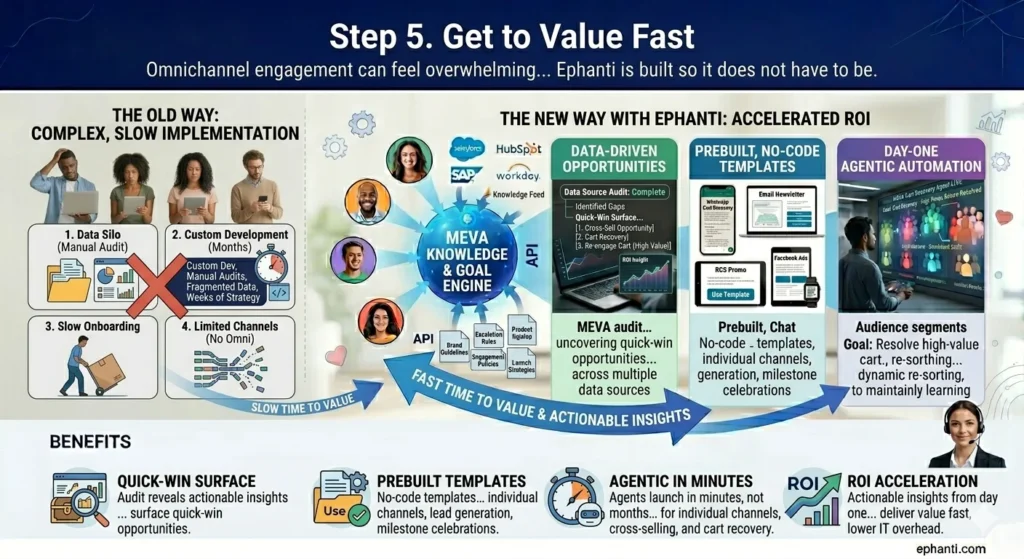
And here is where Ephanti accelerates things further. When you connect your data sources, MEVA’s AI audits your existing customer data and engagement patterns to surface quick-win opportunities before your first campaign even goes live. Instead of spending weeks on manual analysis and strategy sessions, your team starts with actionable insights from the start.
The outcome: faster time to value, lower IT overhead, and a platform that delivers ROI while others are still stuck in implementation.
Pro Tips: What Agentic-First Teams Do Differently
If you are planning to move toward agentic customer engagement, here are the practices that separate the teams seeing real results from the ones still experimenting:
Kill your static templates
Agentic AI thrives on guardrails, not rigid scripts. Give the agent a brand voice, a product catalog, and your engagement policies, then step back. The more room you give agents to reason within boundaries, the more natural and effective every interaction becomes. If you are still manually approving every message variant, you have not made the shift yet.
Start with one agent that solves a real problem
Cart recovery, lead qualification, or post-purchase follow-up are great starting points. Get one agent running well, prove the value with real numbers, then expand. The teams that stall are usually the ones that tried to automate everything at once.
Treat your business knowledge as your most valuable AI asset
Your playbooks, escalation rules, brand guidelines, and product knowledge are what make your agents smart. Invest in keeping them current. An agent is only as good as the knowledge it draws from. Stale knowledge means stale engagement.
Stop measuring channels. Start measuring outcomes.
The real advantage of agentic AI is that it optimizes toward goals, not just open rates. Set clear business outcomes, like recovered revenue, reduced churn, or faster resolution times, and let your agents adapt toward them. Campaign level metrics still matter, but outcome level thinking is what separates ACE from traditional automation.
Let your domain experts own the AI
If every change to agent behavior requires a developer, you have built a bottleneck disguised as innovation. The people closest to your customers should be the ones shaping how agents respond. That is the whole point.
Stay in the director’s chair
ACE does not replace marketers. It replaces the grunt work. Think of yourself as the director of a team of intelligent agents. You set the strategy, define the goals, refine the knowledge, and review the outcomes. Your agents handle the execution, the iteration, and the scale. The best agentic-first teams are not the ones doing less. They are the ones doing higher-value work because their agents handle everything else.
How Ephanti Helps You ACE It
Ephanti is not another tool to bolt onto your existing stack. It is the Agentic Customer Engagement (ACE) platform built for mid-market and enterprise companies that want intelligent, personalized, and automated engagement across every touchpoint.
Here is what that looks like when real brands put it to work.
A growing retail brand consolidated their fragmented tools into Ephanti and deployed MEVA agents for cart recovery. The agents automatically selected the best channel for each customer, personalized price drop notifications based on browsing behavior, and recovered 35% of potentially lost revenue from abandoned carts. Click through rates on recovery campaigns increased by over 12% compared to their previous rule-based approach.
A fast-growing fashion company unified their disconnected customer data with Ephanti, then used MEVA’s agentic orchestration to replace generic coupon-based campaigns with individualized experiences across email, SMS, push, and mobile. Within six months, they saw a 25% increase in customer lifetime value and cut campaign setup time by more than half.
A global beauty brand outgrew their martech stack, consolidated into Ephanti, and used MEVA-powered agents for personalized product recommendations and cross-channel journey orchestration. The result: a 45% increase in lead capture, over 8,500 new identified users, and consistent customer experiences across every communication channel.
In each case, the pattern is the same. Unify data. Deploy agents. Let business experts shape the intelligence. Watch engagement scale without the complexity.
Ephanti delivers MEVA as the engine behind every agent, powering autonomous decisions across Sales, Marketing, and Service. True omnichannel reach across every major channel. Unified customer intelligence with 360 degree profiles and predictive insights. Business-expert driven agent design with no code required. Built-in guardrails and brand safety so agents stay aligned while still being autonomous. Fast deployment with prebuilt agents and integrations for Salesforce, SAP, ServiceNow, and more.
No bloated stacks. No brittle diagrams. Just a smarter way to engage customers, and a platform that gets smarter with every interaction.
Ready to ACE Your Customer Engagement?
The shift from rules based engagement to agentic is happening now. The brands that move first will set the standard. The ones that wait will spend the next two years trying to catch up.
If you are ready to see what Agentic Customer Engagement looks like for your business, let us show you.
