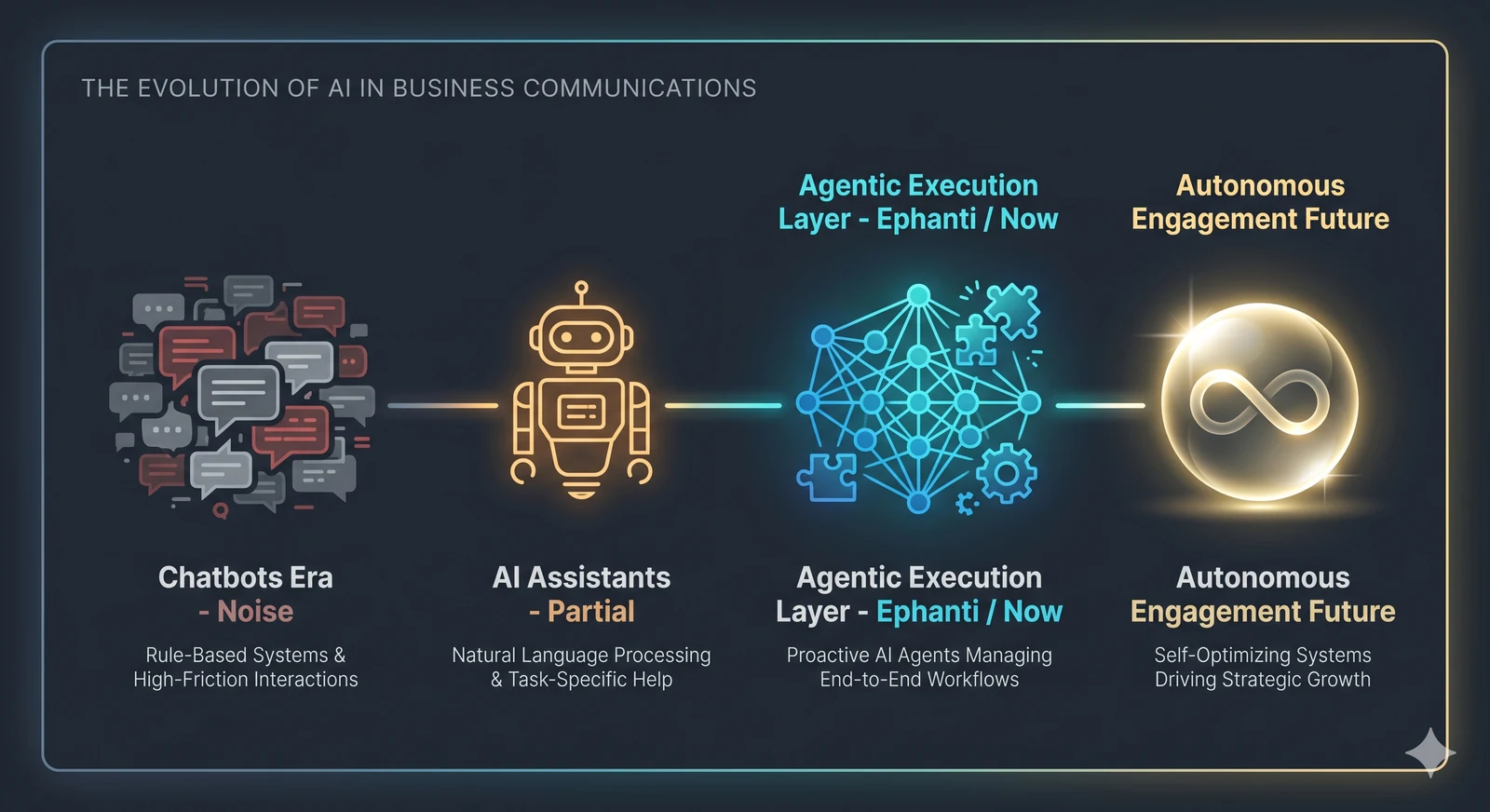
Customer relationships were supposed to get smarter. For ten years, it mostly got noisier. Here's what changed, and what we're committing to.
Walk into any mid-market customer relationship stack in 2026 and you'll find the same thing: eight tools that don't talk to each other, three "AI" products that don't know your business, a pilot from 12 months ago still sitting in a sandbox, and a team that's exhausted.
The promise was that AI would fix this. The reality, mostly, hasn't. The chatbots got better at deflecting. The recommendation engines got better at recommending. The dashboards got prettier. But the actual work: the workflow that follows the conversation, the action that follows the intent, still belongs to humans.
That's not because AI can't do the work. It's because most vendors in this space haven't been built to do the work. They've been built to retrieve work, not to execute work.
The shift is from retrieval to reasoning, and from chat to workflow. Modern reasoning models, the ones built in the last 24 months, can do more than fetch a response from a knowledge base. They can understand intent, evaluate options across multiple data sources, decide the next action, and take it. They can coordinate across specialised sub-agents. They can hold continuous context. They can act on systems of record.
The implication: conversations can become workflows. A customer message doesn't have to end with a response. It can end with the order placed, the refund issued, the renewal booked, the donation made, the trial converted, the upgrade upsold, the ticket closed.
That's not chatbot 2.0. That's a different category of software.
The word "AI agent" gets used loosely. We want to define it precisely:
An agent is a piece of AI that understands intent, decides what to do, and takes action across your systems of record.Not just one action, multi-step actions. Not just one channel, every channel. Not just one customer, every customer, with continuous memory.
The contrast: a chatbot deflects. An assistant suggests. An agent acts.
And critically: an agent is not a black box. This isn't "unleash AI on your customers and hope for the best." Every agent is configurable, auditable, overridable, escalable. The category is defined by what the agent does, with humans firmly in the loop.
It's not CCaaS. CCaaS is contact-centre infrastructure: agent desktops, IVR, workforce management. Ephanti runs on top of CCaaS, or replaces it for digital-native teams.
It's not CRM. CRM is a system of record. Ephanti acts on the CRM (and the ERP, the PMS, the ITSM).
It's not "conversational AI." Conversational AI is a feature: speech-to-text, intent detection, response generation. Ephanti uses conversational AI plus reasoning, multi-agent orchestration, and workflow execution to do the actual work.
It's not "AI customer support." Support is one of six Solutions inside Ephanti. Marketing, Sales, Customer Success, Internal Service, and Social are the others.
If you're evaluating an AI platform for your customer-facing teams in 2026, the question to ask isn't "does it have AI?" It's: does it act?
Specifically: does it read from and write to your systems of record: your CRM, ERP, PMS, ITSM, or does it just chat? Can it execute a multi-step workflow without human handoff? Does it have continuous memory across channels, sessions, and systems? Does it support multi-agent collaboration on shared context? Are there real human-in-the-loop controls, or is the AI a black box? Is it pre-tuned for your industry, or do you have to build everything from scratch?
If the answer to most of those is "yes," you're looking at a platform that does the work. If it's "no, but we have a roadmap," you're looking at chatbot 2.0.
We built Ephanti to run marketing, sales, commerce, and service as one. Not a chatbot vendor. Not an AI add-on to a help desk. The execution layer between your customer conversations and your systems of record.
What that has meant in practice: reasoning-first AI (MEVA, not RAG-only); multi-agent orchestration (six Solutions sharing customer context); industry-tuned packaging (most teams go live within 30 days, not 6-18 months); easy integrations with your existing systems of record; human-in-the-loop by design (override, audit, escalate, tune).
It has also meant: be honest about what we have and don't have. We're not enterprise SaaS. We're not the cheapest. We're not for every team. We're built for mid-market teams in four industries: E-Commerce, Hospitality, B2B SaaS, and Nonprofits, that want to move from chatbots to agents.
Three predictions for AI in customer-facing work in the next 24 months:
The agent will become the surface, not the chat. Today the buyer interacts with a chat window. Tomorrow they interact with an agent: by voice, by message, by in-app, by their preferred channel, knowing it's the same agent.
Workflows will become the unit of competition. Vendors won't compete on chatbot quality. They'll compete on what workflows their agents can execute: cart recovery, trial-to-paid, donor reactivation, reservation orchestration. The wider the workflow library, the wider the moat.
Trust and governance will separate winners from losers. When agents execute, trust matters more than ever. The platforms that win will be the ones with the deepest controls, the clearest audit trail, the strongest compliance story.
If you're a mid-market team running customer relationships in E-Commerce, Hospitality, B2B SaaS, or Nonprofits: and you're tired of pilots that don't ship, tools that don't talk, and AI that doesn't act, Ephanti is built for you.
If you're an analyst, journalist, or category researcher trying to understand this space, we'll happily walk you through what we're seeing and what we believe.
If you're a founder or operator building in this space, we'd love to compare notes. The category is bigger than us; we'd rather have peer category-builders than absent ones.
Common questions about the Ephanti Manifesto
The Ephanti Manifesto outlines the company's vision for the future of customer engagement. It explains why businesses need AI that goes beyond answering questions to helping complete work across marketing, sales, commerce, and customer support.
Ephanti created the manifesto to explain its belief that traditional customer engagement platforms stop at conversations. The company believes AI should help organizations connect customer conversations with business systems to automate meaningful work and improve operational efficiency.
Unlike traditional customer engagement platforms that primarily manage conversations, Ephanti is building the execution layer between customer conversations and systems of record. It brings together AI agents, customer intelligence, and connected business workflows to help marketing, sales, commerce, and customer support teams work from a single platform.
Ephanti provides AI-powered customer engagement solutions for industries including E-Commerce, Hospitality, B2B SaaS, and Nonprofits, with industry-specific workflows designed to support unique business requirements.
Ephanti believes AI should go beyond answering customer questions. Its vision is for AI agents to understand customer intent, determine the next best action, and complete work across connected business systems while allowing organizations to maintain the appropriate level of human oversight.
Ephanti's vision is to transform customer engagement by enabling AI agents to work alongside people, connecting customer conversations with business systems to deliver smarter, faster, and more meaningful outcomes.
The manifesto is intended for business leaders, marketing, sales, commerce, customer support, and technology teams exploring how AI can improve customer engagement, automate workflows, and support business growth.
Yes. The manifesto explains Ephanti's long-term vision for building the execution layer between customer conversations and systems of record, enabling AI agents to orchestrate work across marketing, sales, commerce, and customer support.
The manifesto provides the thinking behind Ephanti's platform strategy. It explains why the company focuses on connecting AI agents, customer intelligence, and business systems to help organizations deliver intelligent customer engagement through a unified platform.
Book a demo or join the Founding Partner program. Either way, we'd love to talk.