Platform · Omnichannel

One inbox. Every channel. Full customer intelligence.

SMS, WhatsApp, email, web chat, voice, social DMs, in-app messaging, unified into one workspace. Unlike ordinary inbox tools, every conversation here is backed by MEVA: persistent customer memory, intent classification, automated workflow execution, and escalation intelligence.

unified inbox · MEVA intelligence CHANNELS WhatsApp · 12 Instagram · 4 Email · 28 SMS · 7 Web chat · 3 Voice · 2 X (Twitter) · 1 Slack · 5 MR Maya Rivera · WhatsApp "Where is my order #4821? 2 days late." → MEVA: Shopify order found · carrier delay confirmed JL Jamie Lee · Instagram "Got the red sneaker in size 9?" TS Tom Schmidt · Email "Refund request for duplicate charge" MEVA CUSTOMER STATE · MAYA RIVERA → VIP customer · 3 prior orders · sentiment: frustrated → Carrier delay confirmed · offered $10 credit → Resolution logged to CRM · Record updated
What makes this different

This is not inbox management

Zendesk routes messages. Intercom sorts tickets. Freshworks manages queues. Ephanti does all of that, and then reasons, acts, and remembers.

🧠

Not just routing, intelligence

Every inbound message is classified by MEVA across 80+ intent categories. Customer state loads: purchase history, open tickets, sentiment trend, churn risk, before a single word of response is drafted. Messages aren't routed. They are understood.

⚙️

Not just response, execution

When a conversation resolves, the outcome writes back to your CRM, ERP, or PMS automatically. The refund is processed. The ticket closes. The order updates. Most inbox tools end at the message. Ephanti ends at the completed workflow.

🔗

Not just history, customer state

Every conversation carries a live customer-state profile: lifetime value, sentiment trajectory, purchase signals, open workflows. Whether the customer is on WhatsApp today or email next week, the state persists, no reset, no context loss, no repeated questions.

Channel coverage

30+ channels, one inbox

Every conversation, across every channel, flows into one unified workspace with shared customer history and MEVA intelligence.

SMSMessaging
WhatsAppMessaging
WhatsApp BusinessMessaging
EmailEmail
Web ChatWeb
Voice (Inbound)Voice
Voice (Outbound)Voice
Instagram DMSocial
Facebook MessengerSocial
TikTok DMSocial
LinkedIn DMSocial
X (Twitter)Social
SlackInternal
Microsoft TeamsInternal
In-app ChatProduct
In-app NotificationsProduct
Push NotificationsMobile
FormsWeb
Booking.comHospitality
TripAdvisorHospitality

Custom channels via channel SDK · typical integration time 1–2 weeks

Lifecycle continuity
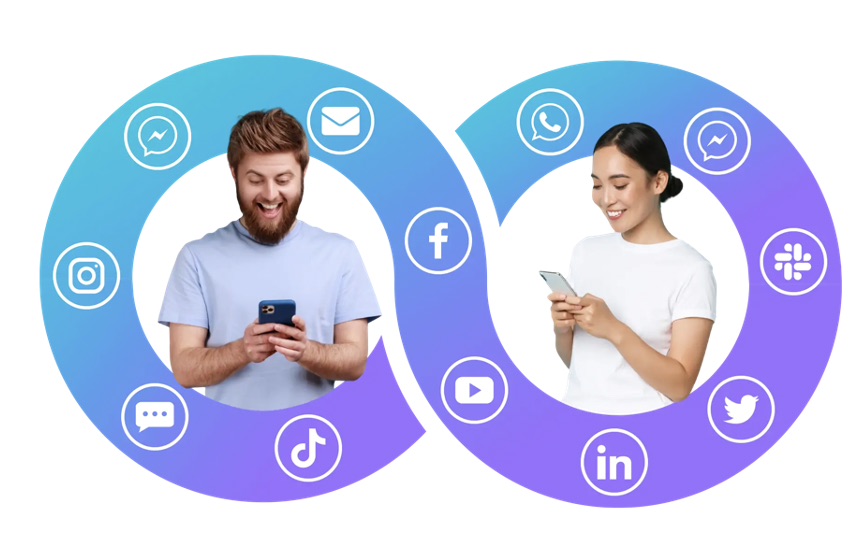
One continuous conversation, every channel, every stage

Customers don't move in straight lines. They jump between channels and loop back around the lifecycle. Ephanti holds it all as one unbroken conversation, picking up with full context wherever it lands.

Continuous omnichannel engagement, every channel, every touchpoint of the lifecycle
Continuous engagement · every channel · every touchpoint of the lifecycle
Context persistence

How context survives channel switches

The hardest problem in omnichannel isn't connecting channels, it's keeping the customer's state coherent when they move between them. Here is how Ephanti solves it.

Identity layer

Channel-agnostic identity resolution

A customer on WhatsApp and the same customer on email are resolved to one profile: using phone, email, CRM ID, and interaction fingerprinting. No duplicate records. No fragmented history.

Memory layer

Persistent cross-session memory

Conversation history doesn't reset at session or channel boundaries. What was said on Instagram last Tuesday is in context when the customer emails on Friday. The MEVA memory layer carries it all forward.

System layer

Live CRM and system sync

Customer state is enriched from your CRM, ERP, and PMS in real time: purchase history, open tickets, loyalty tier, account status. Every agent response starts with a complete picture.

CUSTOMER Unique profile ID IDENTITY RESOLUTION Phone · Email CRM ID · Fingerprint MEVA MEMORY ── All channel history ── CRM · ERP · PMS ── Sentiment trend ── Open workflows ── Churn · upsell signals DELIVERED TO WhatsApp Email Voice Instagram DM Web Chat Context loop — memory always current CUSTOMER STATE · IDENTITY RESOLUTION · PERSISTENT MEMORY · CHANNEL DELIVERY
Context propagation — how customer state flows and persists across every channel switch
Customer-state intelligence

What MEVA knows at the moment of response

Every agent, AI or human, opens a conversation with the customer's full operational profile, not just their last message.

Customer state profile, example

Full conversation history
All prior messages across every channel, ordered chronologically, no session gaps
CRM profile
Lifetime value, loyalty tier, account owner, contract value, last purchase date
Open workflows
Active tickets, pending escalations, in-progress returns, outstanding tasks
Sentiment trajectory
Trend over last 30 days: improving, neutral, or deteriorating. Flagged if at risk.
Churn and upsell signals
Behavioural signals indicating risk or expansion opportunity, updated in real time
Purchase and order history
Last orders, returns, loyalty status, purchase frequency: pulled live from Shopify, SAP, or your ERP

Why this matters for AI responses

When MEVA responds, it isn't answering a message in isolation. It's reasoning over the customer's full history to decide: Is this a VIP who deserves a priority response? Is this a churn risk who needs extra care? Is there an upsell window here? The response adapts accordingly.

Why this matters for human agents

When a conversation escalates to a human, that agent opens the ticket to a fully briefed state profile, not a blank inbox. They see the history, the context, the MEVA reasoning, and the suggested resolution before they type a word.

"The agent doesn't know what channel you came from. They know who you are."

Channel continuity

What a real cross-channel conversation looks like

Customer starts a conversation on Instagram. Moves to WhatsApp. Calls in. Resolved by email. With Ephanti: one ticket, one context, zero repetition.

Step 1 · Instagram

Initial contact

Customer DMs about a delayed order. MEVA classifies intent, loads order history, responds with tracking info. Ticket created.

MEVA: intent = order status · CRM loaded
Step 2 · WhatsApp

Follow-up next day

Customer follows up on WhatsApp. MEVA recognises same customer, loads the Instagram thread, and continues without asking them to repeat.

MEVA: prior context loaded · no reset
Step 3 · Voice

Escalation to human

Customer calls in frustrated. MEVA detects sentiment drop and escalates to a human agent, pre-briefed with the full two-day history and suggested resolution.

MEVA: escalation triggered · agent briefed
Step 4 · Email

Resolution confirmed

Human resolves. Confirmation email sent automatically. CRM updated. Ticket closed. Refund processed. Loyalty points adjusted.

MEVA: CRM updated · ticket closed
1 Insta DM → Order query MEVA classifies intent Ticket created 2 WA Follow-up next day Identity matched No repetition MEVA CUSTOMER STATE — carried through every channel, never reset 3 Voice Escalation to human Agent briefed with 2-day full context 4 Email Resolved · Confirmed CRM updated Ticket closed ✓ One ticket One context Zero repetition
Cross-channel conversation state — Instagram → WhatsApp → Voice → Email · one continuous thread
Escalation intelligence

How escalation actually works

Escalation is not keyword detection. MEVA monitors conversation state continuously and escalates with precision: to the right agent, with the full brief, at the right moment.

Escalation triggers

Sentiment score crosses negative threshold over 3+ messages
High-value customer (>$X LTV) expressing dissatisfaction
Topic complexity exceeds agent confidence threshold
Legal or compliance keywords detected
Customer explicitly requests a human
Refund or dispute exceeds configured dollar threshold
Same issue unresolved across 2+ sessions

What the human receives

Full conversation history across all channels
Customer-state profile (LTV, tier, sentiment trend)
MEVA's reasoning: why escalation was triggered
Suggested resolution with supporting CRM data
Open workflows and pending actions
Priority score and SLA timer
One-click access to CRM record and order history

The human agent doesn't start from zero. They start from a complete brief. That is the difference between escalation that restores confidence and escalation that makes things worse.

Human-AI collaboration

What agents get with every conversation

Human agents work alongside MEVA, not despite it. The inbox is built so that AI handles the routine, assists on the complex, and never leaves a human without context.

Real-time AI suggestions

MEVA drafts suggested responses as the customer types: grounded in customer state, CRM data, and brand voice. The agent edits or approves. Fully configurable by channel and topic.

Next-best-action prompts

Beyond response suggestions: MEVA recommends the next action: apply discount, escalate, send tracking link, schedule callback, create ticket, based on conversation state and customer value.

Cross-channel context panel

Every agent sees the full customer timeline: all channels, all sessions, alongside the live CRM record and open workflows. No switching tabs. No separate CRM lookup.

70+ language translation

MEVA translates inbound messages in real time, with brand voice preserved. Agents respond in their language. Customers receive in theirs.

Channel-native capabilities

WhatsApp commerce flows, Instagram shopping integration, voice IVR, channel-specific features without lowest-common-denominator limitations. Each channel runs at full capability.

Sentiment and risk alerts

Live sentiment scoring with trajectory alerts. Agents are flagged when a conversation is deteriorating before it becomes an escalation, giving them time to intervene proactively.

How Ephanti compares

Ephanti vs. standard inbox tools

Most inbox platforms route messages and manage tickets. Here is what changes when the inbox is powered by an orchestration intelligence layer.

Capability Zendesk Intercom Freshworks Gorgias Ephanti
Unified inbox (30+ channels)YesPartialYesPartialYes, 30+ native
Persistent cross-channel memoryLimitedSession onlyLimitedNoYes, full history
AI intent classification (80+ categories)NoBasicNoNoYes, MEVA native
Customer-state profile (LTV, sentiment, churn)PartialPartialNoNoFull profile, live
Executes workflows in CRM/ERP/PMSNoNoNoNoYes, native write-back
Multi-agent AI coordinationNoNoNoNoYes, shared MEVA memory
Intelligent escalation with full briefRules-basedRules-basedRules-basedRules-basedMEVA-reasoned
Industry-specific reasoningNoNoNoE-com only4 verticals
30+channels out of the box
70+languages supported
<2sAI response time
80+intent categories
1unified queue for all channels

Frequently Asked Questions

Common questions about Ephanti's omnichannel inbox

How is this different from Zendesk or Intercom?

Zendesk and Intercom manage tickets and route messages. Ephanti does that plus: classifies intent using MEVA across 80+ categories, maintains persistent customer state across every channel and session, executes completed workflows in your CRM/ERP/PMS, and coordinates multiple AI agents on the same customer. The core difference is that Ephanti's inbox is backed by an orchestration intelligence layer, MEVA, that turns message routing into operational execution.

What happens to customer context when they switch channels?

Nothing is lost. MEVA's identity resolution layer maps the same customer across channels (using phone, email, CRM ID, and interaction fingerprinting). When they switch from Instagram to WhatsApp to email, the conversation thread, customer-state profile, open tickets, and MEVA reasoning all carry forward. The customer never has to repeat themselves.

How does escalation work?

Escalation triggers are MEVA-reasoned, not keyword-based: sentiment trajectory crossing a threshold, high-value customer dissatisfaction, topic complexity, legal keywords, or explicit customer requests. When escalation fires, the human agent receives a full brief: complete conversation history, customer-state profile, MEVA's reasoning for the escalation, and a suggested resolution, before they type a single word. All thresholds are configurable per industry, channel, and customer tier.

Which channels are supported out of the box?

30+ channels including SMS (Twilio, MessageBird), WhatsApp Business API, email (SendGrid, SES, your own SMTP), web chat, voice (Twilio Voice, inbound and outbound), social DMs (Instagram, Facebook Messenger, TikTok, LinkedIn, X/Twitter), Slack, Microsoft Teams, in-app chat, push notifications, forms, and review platforms (TripAdvisor, Booking.com). Custom channels integrate via the channel SDK in 1–2 weeks.

Can I add a custom channel?

Yes, via the channel SDK. Most custom channels (proprietary apps, niche messaging platforms, internal tools) integrate in 1–2 weeks with standard webhooks and event schema.

Is there a unified queue for agents?

Yes: one workspace, one queue, every channel. Agents filter, sort, and prioritise as they prefer. Conversations can be assigned, escalated, or transferred without losing any context. MEVA handles routine conversations autonomously; only conversations that need human attention reach the queue.

How does WhatsApp Business work?

Ephanti is a Meta-approved WhatsApp Business Solution Provider. We handle template approvals, opt-ins, and message routing. Supported features include two-way messaging, commerce flows (product catalogues, order tracking), interactive messages (buttons, lists), and broadcast campaigns, all with MEVA intelligence and CRM write-back.

See the unified inbox in action.

Book a demo with your actual channels. We will show you what cross-channel customer intelligence looks like in your stack.

Book a demo Watch it work →