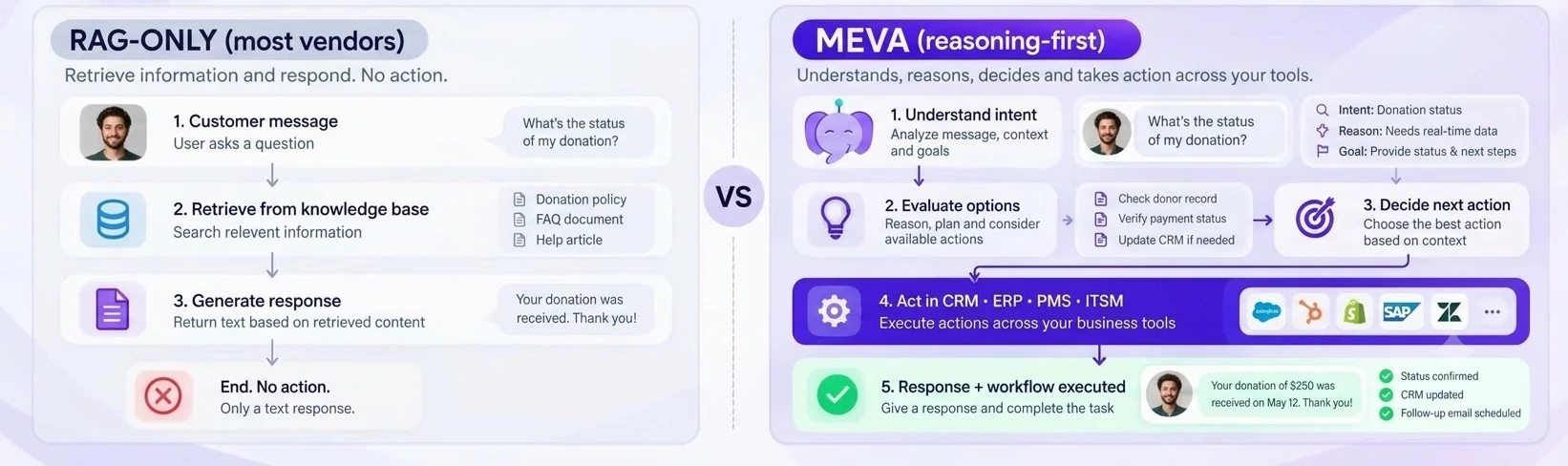
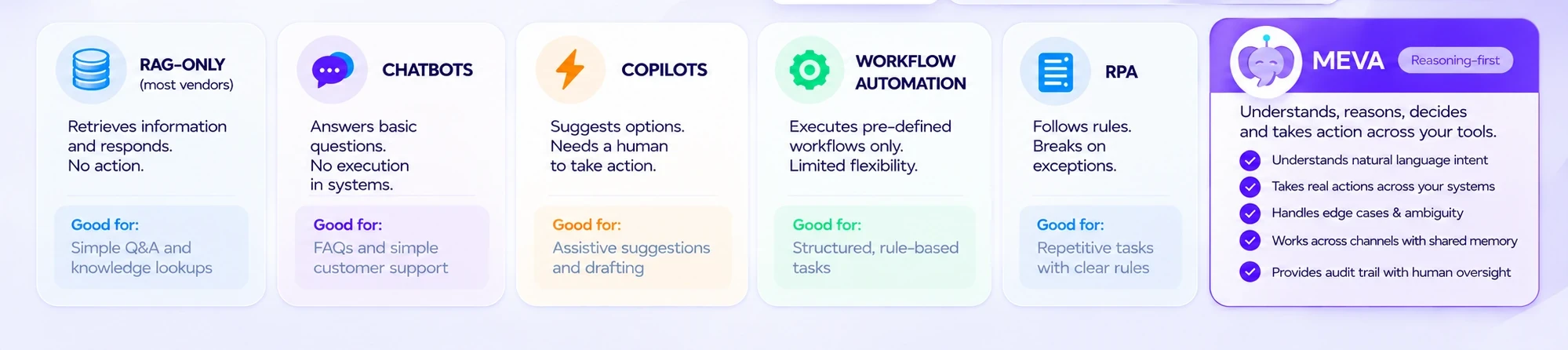
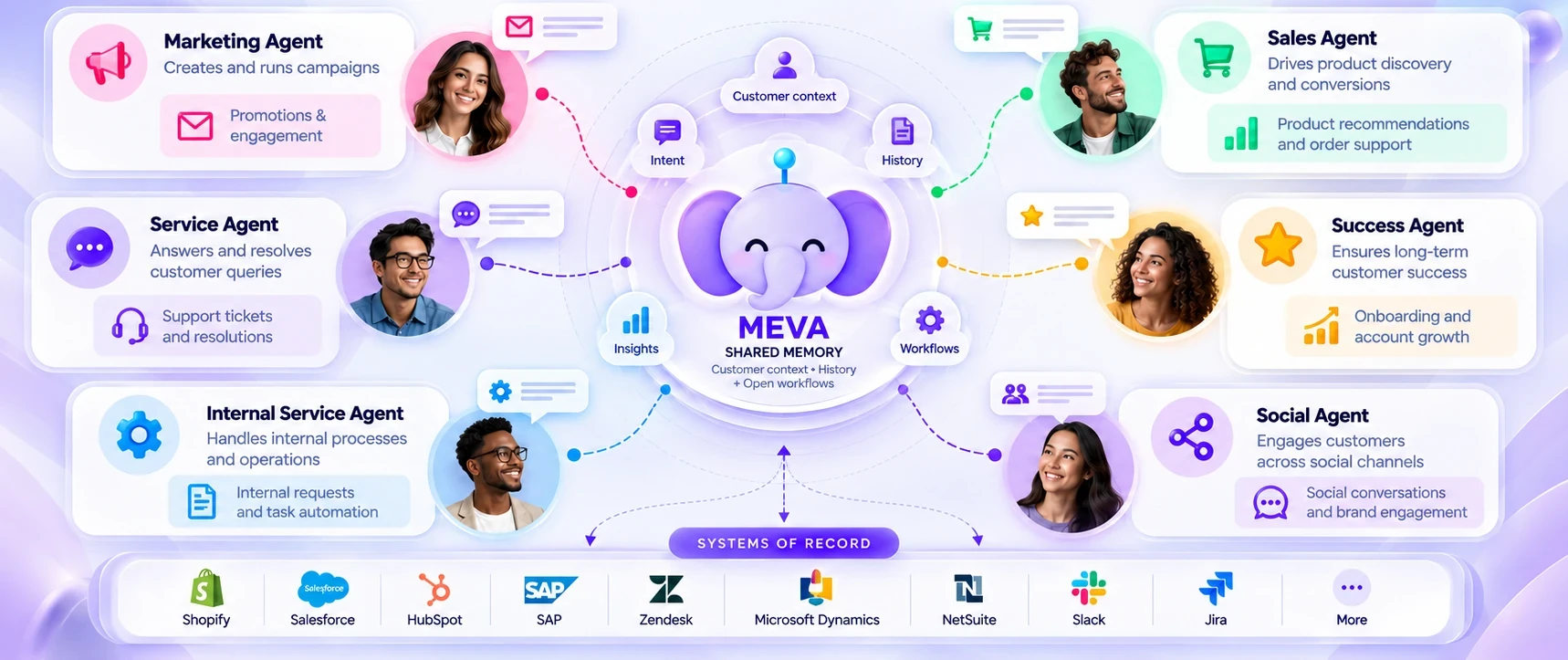
Not a chatbot. Not a copilot. Not workflow automation. MEVA is the runtime that classifies intent, coordinates specialized AI agents, manages persistent customer memory, executes workflows in your systems of record, and audits every decision: across every channel, in real time.
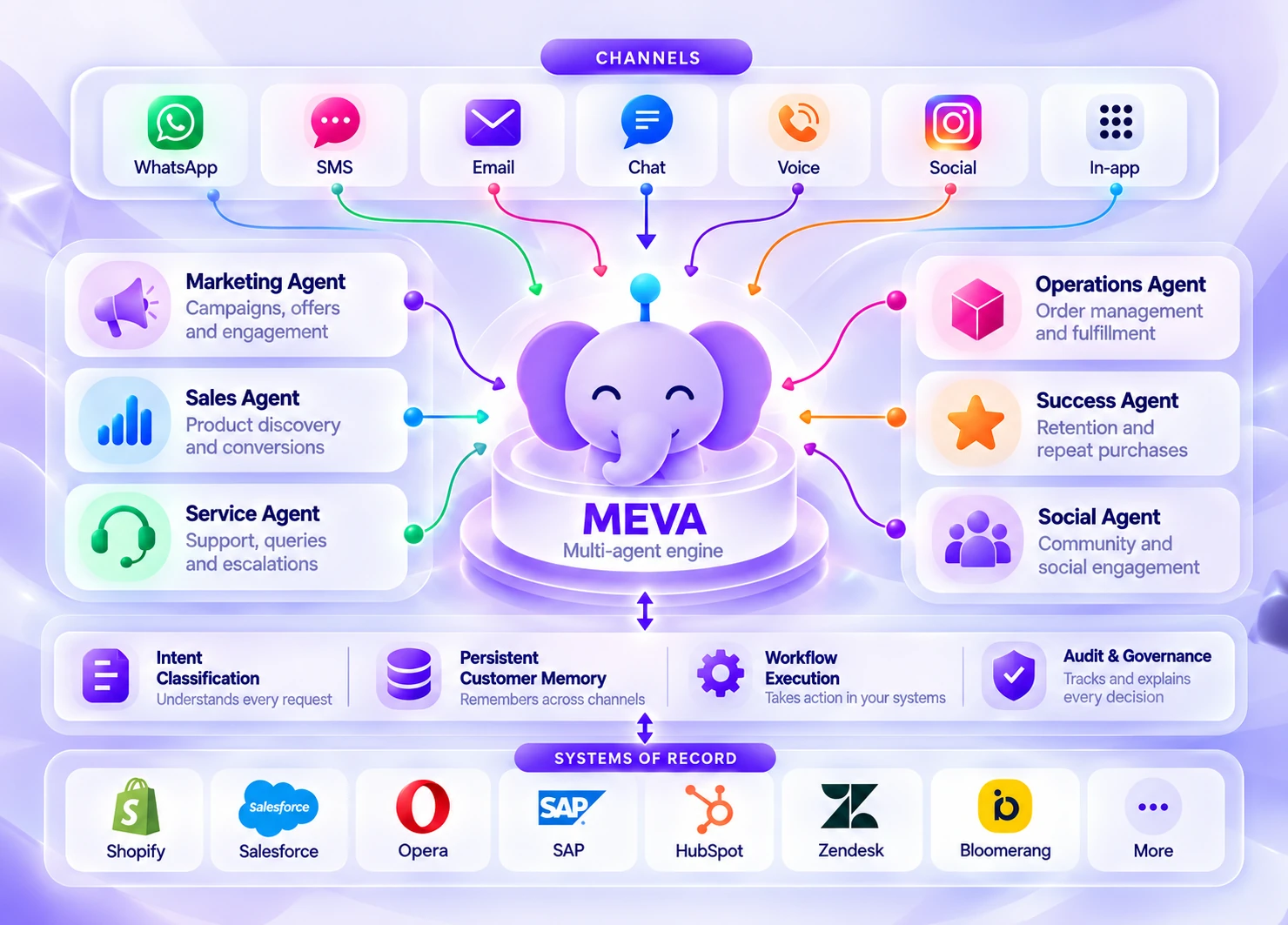
MEVA is Ephanti's multi-agent engine: the runtime that classifies intent, selects and coordinates specialized AI agents, manages persistent customer memory, executes completed workflows in your systems of record, and produces a full audit trail for every decision. It is the difference between an AI that responds and an AI that operates.
A multi-agent engine: the coordination runtime sitting between your customer channels, your AI agents, and your enterprise systems of record.
Receives events, classifies intent, routes to the right agent, loads customer context, decides the next action, executes in your CRM/ERP/PMS, and records the full decision chain.
Not a chatbot, copilot, RPA tool, workflow automation suite, prompt-engineering layer, or rule engine.
Copilots, chatbots, and isolated agents each solve a narrow problem. None of them coordinate. That is where enterprise AI breaks down.
A copilot surfaces a recommendation. A human reads it. Maybe acts. Maybe doesn't. The workflow never closes automatically. The CRM never updates. Velocity stays bottlenecked on human bandwidth.
Marketing bot sends a promo. Service bot closes the same customer's complaint without reading the offer. Sales bot follows up on a churned account. No shared memory means no coordination, only chaos at scale.
Rule-based workflows fail the moment a customer does something unexpected. Without reasoning, the only fix is another rule, and another, and another. Maintenance burden grows faster than automation value.
Enterprises don't need more AI tools in isolation. They need a coordination layer that makes all the pieces work as one coherent operation. That is what MEVA does: it orchestrates specialized agents across your systems.
Every customer interaction, on any channel, passes through the same seven-stage orchestration cycle.
Message arrives on any channel: SMS, WhatsApp, email, chat, voice, social, in-app, and enters the MEVA event bus.
MEVA classifies intent across 80+ categories: purchase intent, complaint, escalation signal, churn risk, support request, upsell window.
Customer memory loads: session history, CRM profile, open tickets, purchase history, prior agent interactions, all in context before reasoning begins.
The orchestrator routes to the right specialist: Marketing, Sales, Service, Customer Success, Internal, or Social agent, or coordinates multiple.
MEVA reasons across context and executes: send message, update CRM record, create order, escalate ticket, apply discount, or notify a human.
Completed workflows write back to systems of record: CRM, ERP, PMS, ITSM, e-commerce platform. The action is done, not just communicated.
Every decision: reasoning chain, action taken, system updated, is logged. Customer memory updates. The loop closes clean.
Under 2s for responses. 4–8s for multi-step workflows. Measured at p95.
MEVA's architecture makes three choices that most AI platforms don't.
Most AI platforms optimize for response quality. MEVA optimizes for operational outcome. The question isn't "did the AI say the right thing?", it's "did the CRM update? Did the workflow complete? Did the ticket close?"
Every agent: Marketing, Sales, Service, Success, operates on shared customer memory. What the Sales agent learned on Tuesday, the Service agent knows on Thursday. Context doesn't reset at channel or session boundaries.
HITL controls, audit trails, escalation logic, and policy guardrails are built into the orchestration layer, not bolted on as a compliance module. Every action is overridable. Every decision is explainable.
Most AI vendors in this space are RAG-only: they retrieve text and respond. That is not enough for execution.
| Capability | RAG-only chatbots | MEVA (reasoning-first) |
|---|---|---|
| Answer FAQs | ✓ | ✓ |
| Look up customer data | Sometimes | Always, connected to CRM |
| Take action in your systems | No | Yes: writes to CRM, ERP, PMS |
| Make multi-step decisions | No | Yes, reasoning across data |
| Multi-agent collaboration | No | Yes, shared context |
| Audit and override | Limited | Full HITL controls |
Every vendor claims AI. Every vendor claims automation. The distinctions that matter are architectural.
| Capability | Chatbots | Copilots | Workflow automation | RPA | MEVA |
|---|---|---|---|---|---|
| Understands natural language intent | Partial | Yes | No | No | Yes |
| Executes actions in systems of record | No | No | Partially | Yes (brittle) | Yes, natively |
| Persistent customer memory | No | Session only | No | No | Yes, cross-channel |
| Multi-agent coordination | No | No | No | No | Yes, shared memory |
| Handles edge cases & ambiguity | No | Partially | No | No | Yes, reasoning-first |
| Human oversight & override | Limited | Yes | Limited | Limited | Full HITL |
| Full audit trail | No | Partial | Partial | Partial | Every decision |
| Industry-specific reasoning | No | No | No | No | Yes, vertical models |
Specialised agents, each an expert in their domain, collaborate on shared customer context. One customer. One memory. Multiple agents working as a coordinated operation.
Marketing, Sales, Service, Customer Success, Internal Service, and Social agents, each trained on their domain's workflows, data, and decision logic.
Cart recovery, trial-to-paid conversion, donor reactivation, reservation confirmation, escalation routing: pre-built, configurable, industry-specific task flows.
When a conversation moves from Marketing to Service to Success, customer memory travels with it. The agent always knows what was said, what was promised, and what is pending.
Most AI systems have amnesia. Each session starts blank. MEVA maintains three layers of persistent memory: across channels, agents, and time.
Full conversation history across every channel. What the customer said on WhatsApp last Tuesday. The complaint raised by email six weeks ago. The promo they clicked on the website. All of it, in context.
Structured customer profile derived from CRM, purchase history, support history, and interaction patterns. Sentiment signals, churn risk scores, LTV estimates, available to every agent at inference time.
Workflow templates, escalation policies, brand voice guidelines, and business rules that govern how agents behave. Configurable per industry, per segment, per channel, without retraining.
Everyone claims AI agents and automation. The moat is not a model; it is the orchestration layer.
Read the full defensibility analysis in the architecture white paper →
The full component reference is in the architecture white paper. In brief, MEVA covers: state management across sessions, 80+ intent categories (p95 under 200ms), 50+ bidirectional connectors with transactional rollback, policy governance, model-agnostic orchestration, and AWS and Azure hosting with SOC 2, GDPR, and SSO.
MEVA is built for enterprise accountability. Every agent action is auditable, overridable, and explainable.
Any agent response can be reviewed and edited before it sends, configurable by agent, channel, or risk score.
MEVA detects negative sentiment, high-value signals, and policy edge cases, and escalates to a human in Slack, Microsoft Teams, or Google Chat, with full context pre-loaded.
Every decision, what it read, reasoned, decided, and sent, is recorded in full: searchable, exportable, ready for compliance review.
See the full governance and configuration model in the architecture white paper →
Orchestration without visibility is not governance. MEVA exposes the full operational picture.
Resolution rate, escalation rate, handling time, and satisfaction signals per agent, channel, and industry, in real time.
The full reasoning chain for every decision, searchable by customer, date, agent, or action type.
Every workflow from trigger to close: completion rate, drop-off, write-back success, and latency at p50, p95, p99.
Full observability and audit detail is in the architecture white paper →
Deep dive for technical evaluators: orchestration model, multi-agent coordination, memory architecture, integration fabric, governance framework, and deployment options.
Common questions about the MEVA AI engine
MEVA goes beyond assisting with individual tasks. It coordinates AI agents, customer intelligence, and business workflows to help organizations manage customer engagement across marketing, sales, commerce, and customer support.
MEVA orchestrates multiple AI agents by connecting shared customer context, business rules, and workflow logic across business systems. This enables AI agents to work together while maintaining consistency, governance, and operational efficiency.
MEVA is designed to power AI-driven customer engagement across business workflows. AI model selection and deployment options depend on an organization's business, performance, and compliance requirements.
Response times depend on factors such as workflow complexity, connected business systems, and deployment configuration. MEVA is designed to support responsive AI-powered customer engagement while maintaining reliable workflow execution.
MEVA is built with enterprise security and compliance considerations. Deployment, data hosting, and compliance capabilities are determined based on organizational requirements and the selected deployment model.
Yes. MEVA integrates with CRM, ERP, commerce, hospitality, and other business systems, enabling AI agents to access customer context and coordinate business workflows without requiring organizations to replace their existing technology stack.
MEVA supports enterprise security through role-based access controls, audit logging, data protection measures, and governance capabilities that help organizations manage AI-powered workflows responsibly.
Yes. MEVA is designed for organizations that require scalable AI orchestration, enterprise integrations, security controls, and governance capabilities across multiple business functions.
MEVA is designed for organizations across multiple industries that want to automate customer engagement, coordinate AI agents, and connect business workflows through a unified platform.
MEVA connects AI agents, customer intelligence, and business systems to help organizations deliver more consistent, personalized, and intelligent customer engagement while supporting business workflows across the customer lifecycle.
Architecture deep dives for technical evaluators. Security reviews for procurement. Sandbox access for POC.