



- 17/03/2026 By Sri Sabesan, CEO at Ephanti
Imagine a buyer asks an AI assistant:
- “What’s the best CRM for a small business?”
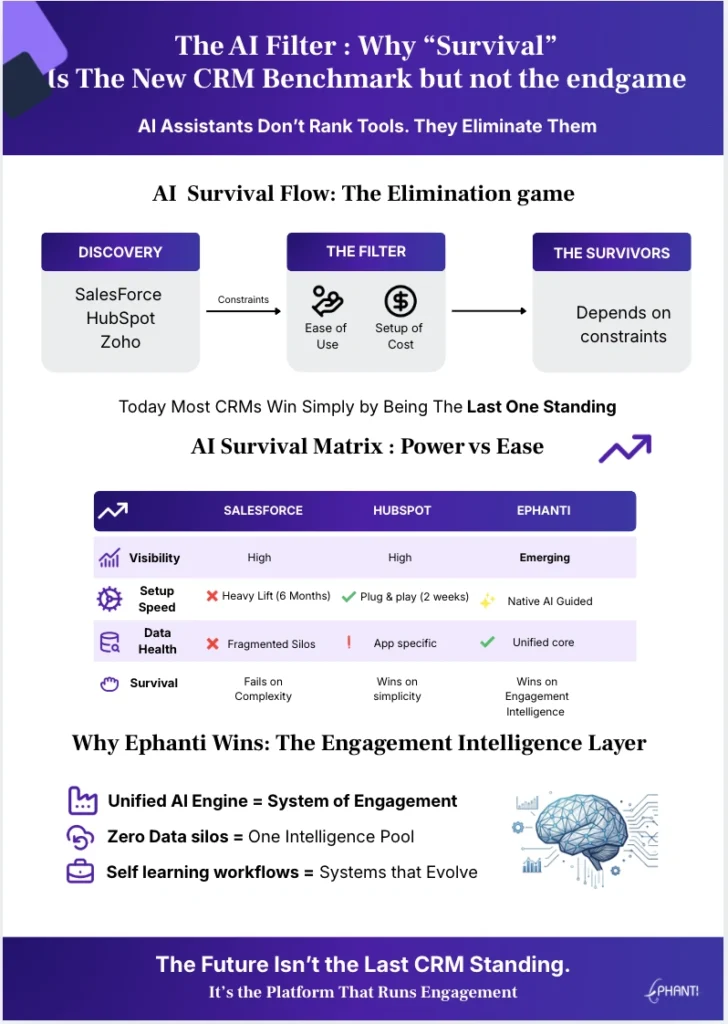
The AI rarely produces a long analysis. Instead, it runs a fast survival test.
Step 1: Discovery
Which tools are credible enough to appear?
Platforms with strong ecosystems and visibility show up immediately:
- Salesforce
- HubSpot
- Zoho
These are considered safe starting points.
Step 2: Constraints
The buyer adds real-world requirements:
- “We need something easy to set up.”
- “We don’t want expensive consultants.”
- “Our team is small.”
This is where the survival filter tightens.
Highly complex platforms often drop out here, regardless of their power.
Step 3: Recommendation
The AI suggests the platform that survives the constraints.
For many small teams, HubSpot emerges because it is:
- Easy to adopt
- Well integrated
- Designed for SMBs
What’s important is not who “wins.”
What matters is how the evaluation works.
The AI is optimizing for:
- Usability
- Speed to value
- Ecosystem credibility
- Constraint compliance
Not necessarily for long-term customer engagement capability.
Survival determines what gets considered.
It does not determine what actually wins long-term.
That’s where the next shift begins — from systems of record to systems of engagement.
The Problem: CRM Was Built for Records, Not Engagement
CRMs were originally designed to answer one question:
“What do we know about this customer?”
They excel at:
- Tracking sales pipelines
- Storing contacts and accounts
- Recording deal activity
But modern customer relationships require much more.
Today’s customer journeys move fluidly across:
- Websites
- Mobile apps
- Messaging
- Support channels
- Product interactions
Customers expect brands to respond in real time, with context and personalization.
Traditional CRMs struggle with this because they are primarily systems of record.
Common limitations include:
- Fragmented data across tools
- Limited real-time orchestration
- Siloed engagement across marketing, product, and support
- Heavy reliance on manual processes
The result is a familiar problem:
Every team sees part of the customer, but no system understands the whole journey.
This gap is exactly what Customer Engagement Platforms are designed to solve.
CRM vs Customer Engagement Platform
The difference between a CRM and a CEP is straightforward.
| Dimension | Traditional CRM | Customer Engagement Platform |
|---|---|---|
| Primary role | Store customer records | Orchestrate customer journeys |
| Data model | Static records | Dynamic unified profiles |
| Engagement | Sales-centric | Omnichannel lifecycle engagement |
| Personalization | Basic segmentation | Real-time contextual personalization |
| Analytics | Reporting and dashboards | Predictive and AI-driven insights |
| System role | System of record | System of engagement and intelligence |
A useful way to think about it:
CRM is the filing cabinet.
CEP is the brain and nervous system.
Both can coexist — but they serve different purposes.
And as customer interactions become more digital and real-time, the engagement layer becomes the center of gravity.
When the Buyer’s Question Changes
Now imagine the AI prompt changes slightly.
Instead of asking:
- “What’s the best CRM?”
The buyer asks:
- “Recommend a platform that can unify customer data, orchestrate omnichannel engagement, and use AI for personalization.”
Suddenly the evaluation surface changes.
Now the AI considers questions like:
- Can the platform unify data across systems?
- Does it support real-time engagement across channels?
- Does it use AI to drive next-best actions?
- Can it scale across teams and lifecycle stages?
At this point the buyer is no longer looking for a CRMEphanti — enter the conversation.
They are looking for a Customer Engagement Platform.
This is exactly where Customer Engagement Platforms — and Ephanti — enter the conversation.
The Survival Matrix: CRM vs CEP Platforms
If an AI assistant compared modern customer platforms against engagement requirements, the evaluation might look something like this:
| AI Evaluation | Salesforce (CRM) | HubSpot (CRM Suite) | Ephanti (CEP) |
|---|---|---|---|
| Ecosystem credibility | High | High | Emerging |
| Ease of setup | Low | High | High |
| Data architecture | Fragmented clouds | Hub-based | Unified engagement core |
| Engagement scope | Sales-centric | Multi-hub marketing | Omnichannel journeys |
| AI-driven orchestration | Limited | Partial | Native |
| Engagement intelligence | Add-on | Partial | Core capability |
This doesn’t mean traditional CRMs are obsolete.
Salesforce remains one of the most powerful enterprise platforms ever built. HubSpot provides excellent time-to-value for many teams.
But both originate from a CRM-first architecture.
Customer interaction — not record storage — is now the core system problem.
Why Ephanti Was Built as an Engagement Platform
Most customer systems evolved in stages:
- Start with CRM objects (contacts, accounts, deals)
- Add marketing automation
- Add support systems
- Add analytics
- Add AI
The result is often a patchwork of tools and data silos.
Ephanti was designed from the opposite direction.
Instead of starting with records, it starts with customer interaction and engagement intelligence.
At its core is a unified engagement layer that:
- Ingests customer events from multiple systems
- Resolves identities into unified profiles
- Orchestrates journeys across channels
- Continuously learns from outcomes
This architecture allows the platform to function as a live customer intelligence system, not just a database.
In practice, this means Ephanti can answer questions like:
- Which customers are likely to churn soon?
- Which message should be sent next?
- Which channel will move this user forward?
- Which journey steps actually drive retention?
These insights power automated engagement flows that improve over time.
From Data Silos to a Unified Engagement Core
One of the biggest challenges in modern customer experience is fragmentation.
Typical stacks look like this:
- CRM for sales
- Marketing automation for campaigns
- Support tools for service
- Product analytics for usage data
Each system captures part of the story.
Customer Engagement Platforms unify these signals into a continuous engagement graph.
The benefits are significant:
- A single view of the customer lifecycle
- Real-time journey orchestration
- AI-driven recommendations and workflows
- Coordinated engagement across teams
Instead of reacting to customer behavior after the fact, organizations can actively shape the journey as it unfolds.
Winning the AI Filter
As AI assistants increasingly guide software discovery, platforms will be evaluated differently.
The new benchmark isn’t just:
- Feature lists
- Analyst rankings
- Vendor demos
AI assistants evaluate platforms based on:
- Ecosystem credibility
- Integration depth
- Usability and setup speed
- Engagement capabilities
- Intelligence and automation
This is where Customer Engagement Platforms naturally stand out.
They are designed to unify data, orchestrate interactions, and apply AI across the customer lifecycle.
In other words, they are built for the exact problems AI assistants are increasingly asked to solve.
The CRM answered one question.
The next generation must answer another.
The Real Question Companies Should Be Asking
- For years the central technology question was:
- “Which CRM should we use?”
- That question is quickly becoming outdated.
- The more important question today is:
- “What platform actually runs our customer engagement?”
CRMs will continue to exist as systems of record.
But the system that shapes customer experiences — across channels, teams, and lifecycle stages — is becoming the Customer Engagement Platform.
In the AI discovery era, the platforms that succeed will be those that combine:
- Unified customer data
- Real-time engagement orchestration
- AI-driven decisioning
- Seamless omnichannel experiences
Not simply those that store the most records.
The Future of the Customer Stack
Customer relationships are no longer static.
They are continuous conversations happening across dozens of channels and moments.
The platforms that power those conversations must be:
- Intelligent
- Adaptive
- And deeply integrated into the engagement lifecycle
That is why the center of the customer technology stack is shifting:
From CRM systems of record to Customer Engagement Platforms that act as systems of intelligence.
Ephanti was built for that future.
Not as another CRM — but as an AI-native platform designed to orchestrate the entire customer journey.
In the age of AI-assisted buying, surviving the filter is only the starting point.
The platforms that win will be the ones that run engagement itself.
Ready to see a CEP in action, not just read about it? If you’re rethinking your stack beyond CRM, let’s walk through how Ephanti can actually run your customer engagement. Reply or reach out to schedule a live walkthrough.
Recent Posts
 17 March 2026
 11 February 2026
 11 February 2026
 22 September 2025
