



- 17/03/2026 By Sri Sabesan, CEO at Ephanti
E‑commerce has a hidden conversion leak: the search bar. Brands spend thousands every month driving traffic to their store—but the moment a real human question goes into the search box, the site behaves like it’s still 2015. A nuanced query goes in, and out comes either “0 results found” or a generic grid of products that misses the point.
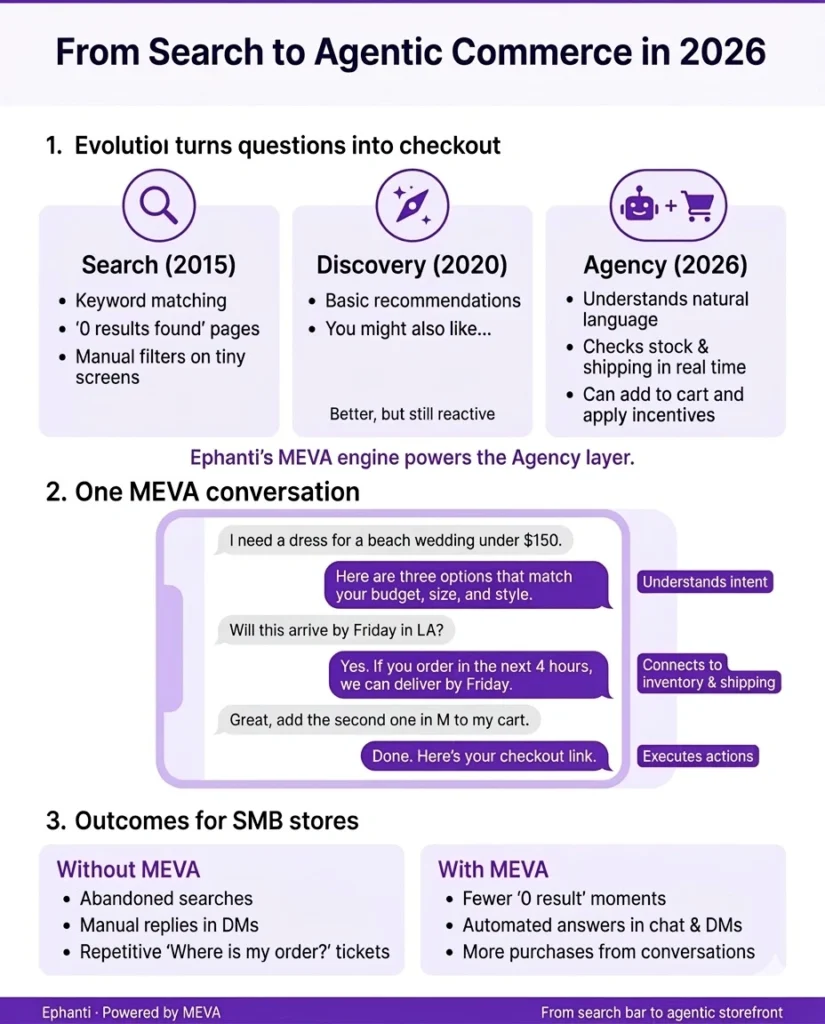
This isn’t just annoying; it’s expensive. Visitors who use search are 2–3x more likely to convert than non‑search users, but only if they actually find something relevant. In 2026, keyword matching isn’t enough. We’re moving from Search (find a needle in a haystack) to Discovery (the needle finds you) and now to Agency (the needle acts on your behalf).
Ephanti is building for that shift with MEVA, our AI Agent—and a new standard we call Agentic Commerce.
1. The Crisis of Traditional Site Search
Traditional site search is passive and fragile. It depends on exact keywords and rigid filters. If the shopper doesn’t search the way your catalog is labeled, the sale quietly dies.
For a typical Shopify or WooCommerce store, that shows up as:
Lost high‑intent traffic
30–40% of shoppers go straight to the search bar, and those who search are 2–3x more likely to buy — if search works.
Abandoned intent
Shoppers now think in prompts, thanks to GenAI. They don’t type “blue dress”; they type, “I need something breathable for a summer wedding in Greece that hides a bloated stomach.” Legacy search has no idea what to do with that.
Filter fatigue
Filter fatigue: Expecting a customer to fight through 10–15 side filters on mobile is a recipe for “back button → competitor site.”
For a store owner, the question is simple: why pay for traffic if your search bar can’t understand what buyers actually want?
2. Introducing MEVA: From Search Box to Execution Layer
At Ephanti, we didn’t build “a better chatbot.” We built MEVA, the execution layer that sits on top of your existing store.
If traditional search is a librarian who points you to a shelf, MEVA is a personal shopper and store assistant that can answer questions, find products, check stock, and complete actions.
1)Think in terms of the conversations you already see every day:
- “Do you have this in size L?”
- “Can I get something like this Zara jacket but under $80?”
- “Will this arrive before Saturday if I order today?”
2) Here’s what MEVA does differently:
-
Understands real language:
- MEVA can handle “I need a dress that hides my tummy for a beach wedding”
- Turns it into relevant, shoppable recommendations instead of a blank page
-
Acts across your systems:
- Answers queries like “Will it arrive by Friday?”
- Checks real-time inventory, warehouse status, and shipping cutoffs
- Provides confident and accurate responses
-
Solves problems, not just chats:
- Suggests upsells
- Applies discounts within defined rules
- Answers “Where is my order?” queries
- Resolves routine issues without opening a support ticket
So instead of “another chatbot that annoys customers,” you get an assistant that actually reduces tickets and drives more checkouts.
3. Omnichannel, Without the Chaos
Customers don’t just search on your website anymore. They ask product questions in:
- Instagram DMs
- SMS
- (Even email and contact forms)
Most stores answer those manually, one by one. That means slow replies, missed messages, and no central view of what the customer actually wants.
Ephanti’s Agentic Search turns those messy touchpoints into one continuous, automated flow:
- WhatsApp and DMs: A shopper sends a photo of a celebrity outfit on WhatsApp or Instagram. MEVA finds the closest matches in your catalog, checks stock, and replies with “Buy now” links.
- Guided discovery in chat: Instead of dumping followers onto a confusing homepage from “link in bio,” MEVA runs a real discovery conversation inside DMs—“What size are you? What’s your budget? When do you need it?”—and then builds a cart.
- One inbox for your team: All those conversations—site, WhatsApp, Instagram, SMS—land in a single, unified inbox. You see the full history and can jump in when needed, but MEVA handles the repetitive work.
For SMBs, this isn’t “fancy omnichannel strategy.” It’s “stop drowning in DMs and support messages and let an agent handle the repetitive questions.”
4. From “AI Pilot” to Real Revenue (Without Breaking Your Stack)
Over the past two years, many merchants tried “AI chatbots” and ended up disappointed. They answered FAQs but couldn’t actually help someone find a product, check stock, or place an order.
Ephanti is built for a different outcome: live revenue impact, on your existing stack.
01
No rip and replace:
Ephanti doesn’t replace your store. It plugs into your current stack—Shopify, Shopify Plus, Magento, WooCommerce, and others—and uses your existing catalog, inventory, and customer data to power intelligent conversations.
02
Fast to implement:
Because we sit on top of your platform and work with your existing data models, setup is measured in days or weeks—not a 6–12 month migration.
03
Reduces support workload:
Agentic flows can handle routine “Do you have this in my size?”, “Will this arrive in time?”, and “Where is my order?” questions automatically, reducing manual tickets and freeing your team for high-value interactions.
04
Better insights, not just transcripts:
MEVA doesn’t just log chats—it understands the “why” behind questions. You see where customers get stuck, what they ask for that you don’t have, and which conversations consistently convert.
No rip and replace:
Ephanti doesn’t replace your store. It plugs into your current stack—Shopify, Shopify Plus, Magento, WooCommerce, and others—and uses your existing catalog, inventory, and customer data to power intelligent conversations.
Fast to implement:
Because we sit on top of your platform and work with your existing data models, setup is measured in days or weeks—not a 6–12 month migration.
Reduces support workload:
Agentic flows can handle routine “Do you have this in my size?”, “Will this arrive in time?”, and “Where is my order?” questions automatically, reducing manual tickets and freeing your team for high-value interactions.
Better insights, not just transcripts:
MEVA doesn’t just log chats—it understands the “why” behind questions. You see where customers get stuck, what they ask for that you don’t have, and which conversations consistently convert.
For many stores, improving search relevance and reducing “zero result” searches can mean 2–3x higher conversion from search users and a 20–40% reduction in search abandonment.
5. The Competitive Advantage for 2026‑Ready Stores
For SMB and mid‑market brands, the pressure is simple: if your store makes customers work to find what they want, they leave in seconds and buy from someone who understands their intent.
Agentic commerce fixes that:
- Fewer abandoned searches: Shoppers can ask questions the way they speak, and MEVA understands—so they see relevant products instead of empty results.
- Fewer “where is my order?” tickets: Routine post‑purchase questions get handled by the agent, not your already‑busy support team.
- More purchases from chat: Conversations in search, DMs, and messaging channels become a direct path to checkout—not just another inbox to manage.
In a world where anyone can copy your products, ads, or theme, experience is the moat. Agentic commerce is how smaller brands compete like much larger ones—without hiring a much larger team.
Conclusion: Stop Losing Customers at the Search Bar
The old search bar is no longer neutral—it’s a leak in your funnel. The Agentic Storefront is the new default for stores that want to turn intent into action, not abandonment.
With Ephanti and the MEVA engine, your shoppers can ask real questions, get real answers, and complete real actions—on your site, in DMs, and across messaging—24/7. A shopper can say, “I need a dress for a beach wedding under $150,” and instead of a blank search page, they get tailored recommendations, delivery timing, and a clear checkout path—instantly.
See how MEVA turns everyday product questions into purchases. Book a live walkthrough
Recent Posts
 17 March 2026
 11 February 2026
 11 February 2026
 22 September 2025
